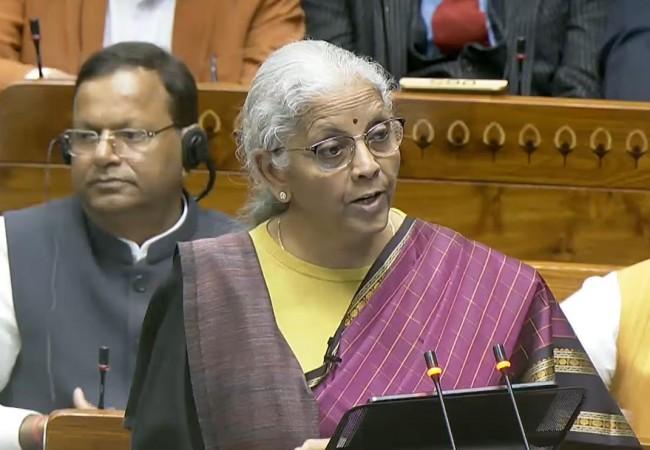
Finance Minister Nirmala Sitharaman on Sunday said the Union Budget 2026–27 is designed to accelerate economic growth and generate employment across sectors through structural reforms, productivity enhancement and sustained economic expansion.
Addressing journalists after presenting the Budget, the Finance Minister said it focuses on building an ecosystem that supports job creation while maintaining growth momentum. She added that the emphasis on reforms, innovation and employment reflects the government's push for a tech-driven and inclusive economic framework.
Highlighting key proposals, Sitharaman said the Rs 10,000 crore outlay earmarked for the biopharma sector over the next five years would help India retain its leadership position globally. "The investment ensures India maintains its lead in the biopharma sector," she remarked.
Health has been given equal priority in this year's Budget, with special emphasis on mental health. The allocation for the Ministry of Health and Family Welfare has been increased to Rs 1,06,530.42 crore, nearly 10 per cent higher than the Revised Estimates of FY 2025–26.
The Budget also proposes the creation of one lakh Allied Health Professionals across 10 disciplines, including optometry, radiology and anaesthesia, over the next five years. In addition, more emergency and trauma centres and mental health institutions such as NIMHANS will be set up. Sitharaman further announced the creation of 1.5 lakh caregivers under geriatric and NSQF-aligned programmes.
Expressing optimism about the proposed rare earth corridors, the Finance Minister cited the success of defence corridors as an example of how such initiatives can strengthen strategic sectors.

She said the Budget is the first of the second quarter of the century and aligns with the vision of making India a developed nation by 2047 under the principle of "Sabka Saath, Sabka Vikas". Responding to queries on the absence of special provisions for poll-bound states, Sitharaman quipped that the government faces criticism either way.
Meanwhile, industry leaders welcomed the Budget, calling it a credible roadmap that boosts confidence in India's growth story. Speaking to IANS, CII Punjab Chairman Amin Jain said key announcements for the textile sector — including mega textile parks, integrated plans for labour-intensive segments and redevelopment of heritage textile parks — would significantly benefit the industry.
Jain also welcomed the Rs 10,000 crore MSME fund, noting that textiles account for the largest number of MSMEs in the country.
Naresh Pachisia, President of the India Chambers of Commerce, described the Budget as well-balanced and said it would help sustain economic growth at around 7 per cent. He added that targeted sectoral schemes and strong fiscal discipline would help keep inflation under control.
"The fiscal deficit has been pegged at 4.4 per cent for the current year, with a target of 4.3 per cent for the next fiscal, providing resilience against global volatility," Pachisia said.
Mukul Bagla, Chairman of the Direct Tax Committee at PHDCCI, said the Budget focuses on stability while continuing fiscal consolidation, with plans to gradually reduce the fiscal deficit to 4 per cent.
Ashok Batra, Chairman of the Indirect Tax Committee at PHDCCI, welcomed reforms related to customs, though he noted that similar changes were expected in the GST framework.
Union Finance Minister Nirmala Sitharaman on Sunday hit back at Congress leader Rahul Gandhi's criticism of the Union Budget, stressing that the budget focuses on small and medium enterprises, farmers, and people working in rural areas amid global uncertainty.
"Politically, you want to criticise, you're welcome, please do it. But if you want to give me the facts on which you're basing your argument, I'm willing to hear and willing to reply to that," the Union Finance Minister said.
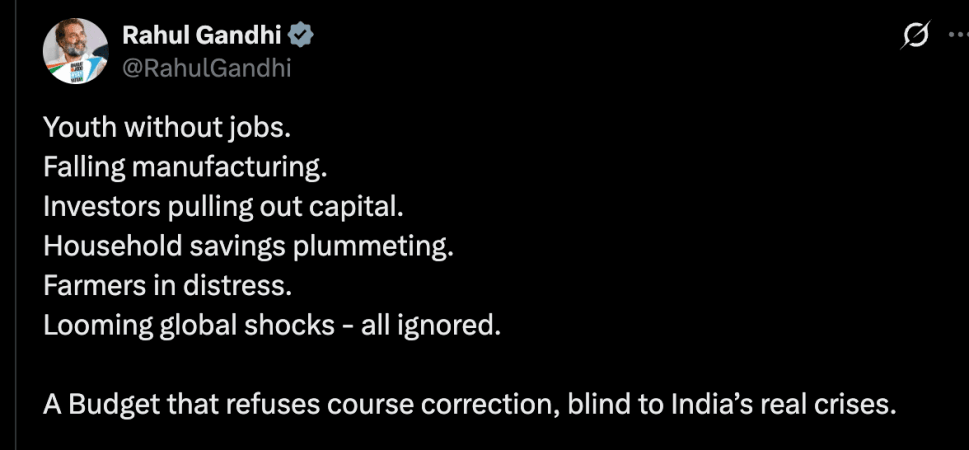
The leader of Opposition in Lok Sabha, Rahul Gandhi, had taken to X earlier, describing the budget as being blind to India's real crises, highlighting issues such as rising unemployment, falling manufacturing, capital outflows, declining household savings, farmers' distress, and looming global shocks. He accused the government of refusing course correction and failing to address the urgent challenges facing the country.
Reacting to the remarks, Sitharaman said, "I don't know what course correction he is referring to. The economy and its fundamentals are strong. Global uncertainty is facing many of our sectors, for whom we have brought in so many different schemes for those small and medium enterprises, for textiles, for leather, for people who are working in the rural areas, schemes for benefiting them, for even the farmer and value addition, for women entrepreneurs, and self-help entrepreneurs."
Earlier in the day, Rahul Gandhi slammed the Union Budget 2026-2027, saying it is blind to India's real crisis and refuses course correction.
"Youth without jobs. Falling manufacturing. Investors pulling out capital. Household savings plummeting. Farmers in distress. Looming global shocks - all ignored. A Budget that refuses course correction, blind to India's real crises," Gandhi wrote on X.
Earlier today, Finance Minister Nirmala Sitharaman presented the Union Budget 2026-27 in Lok Sabha, her ninth consecutive Union Budget.
Asserting that the Union Budget 2026-27 is driven by "Yuvashakti" and based on "three kartavyas," Union Finance Minister Nirmala Sitharaman on Sunday proposed seven high-speed rail corridors, new dedicated freight corridors, and the operationalisation of 20 national waterways over the next five years as part of the Union Budget.