
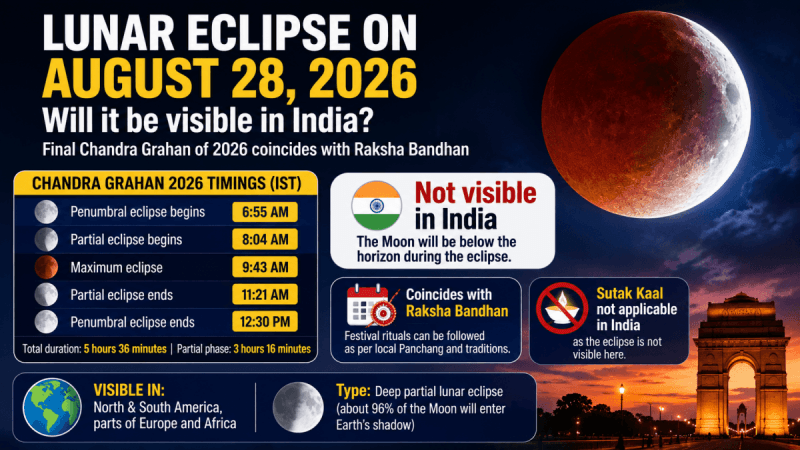
The final lunar eclipse of 2026 will take place on Friday, August 28, coinciding with Raksha Bandhan. However, skywatchers in India will not be able to see the celestial event as the Moon will remain below the horizon during the eclipse.
The partial lunar eclipse will begin at 8:04 am IST and reach its maximum phase at 9:43 am. The entire eclipse, including the penumbral phases, will last around five hours and 36 minutes.
Chandra Grahan 2026 timings in India
According to the timings cited in the report, the eclipse will progress through the following phases:
- Penumbral eclipse begins: 6:55 am IST
- Partial eclipse begins: 8:04 am IST
- Maximum eclipse: 9:43 am IST
- Partial eclipse ends: 11:21 am IST
- Penumbral eclipse ends: 12:30 pm IST
The partial phase will last around three hours and 16 minutes.
Will the lunar eclipse be visible in India?
No. The August 28 lunar eclipse will not be visible from India because the Moon will be below the horizon during the relevant phases.
The eclipse will be visible from several parts of North and South America, as well as parts of Europe and Africa. Some other regions may witness portions of the penumbral phase.
Will Sutak Kaal apply in India?
Since the eclipse will not be visible in India, the traditional Sutak Kaal associated with a visible lunar eclipse is not considered applicable, according to the Panchang-based practice cited in the report.
People who follow specific family or regional traditions may continue to observe their customary practices.
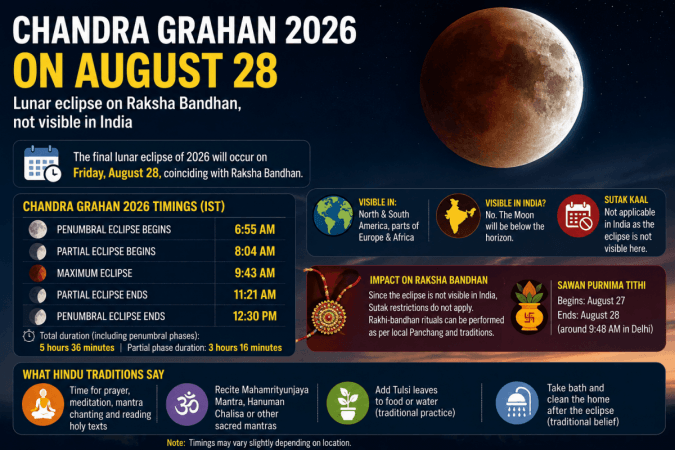
What is the impact on Raksha Bandhan?
The lunar eclipse falls on the same day as Raksha Bandhan this year, which has led to questions about whether the festival's rituals will be affected.
Since the eclipse cannot be seen from India, traditional Sutak restrictions linked to a visible eclipse are not considered applicable. Devotees can therefore follow the Raksha Bandhan timings and rituals prescribed by their local Panchang and family traditions.
The Sawan Purnima Tithi began on August 27 and continues into August 28. The cited Panchang calculation puts the end of Purnima at around 9:48 am in Delhi, although timings can vary slightly depending on location.
What do Hindu traditions say about Chandra Grahan?
Lunar eclipses have traditionally been regarded as spiritually significant in Hindu households. Families that observe eclipse-related customs may use the period for prayer, meditation, mantra chanting or reading religious texts.
Practices such as reciting the Mahamrityunjaya Mantra or Hanuman Chalisa are followed by some devotees. Adding Tulsi leaves to food or water and bathing or cleaning the home after an eclipse are also traditional practices in some households.
These practices are based on religious and cultural traditions rather than scientific requirements.
For people in India, the key takeaway is that although Chandra Grahan 2026 coincides with Raksha Bandhan, the eclipse will not be visible from the country, and traditional Sutak restrictions associated with a visible eclipse are therefore not considered applicable.