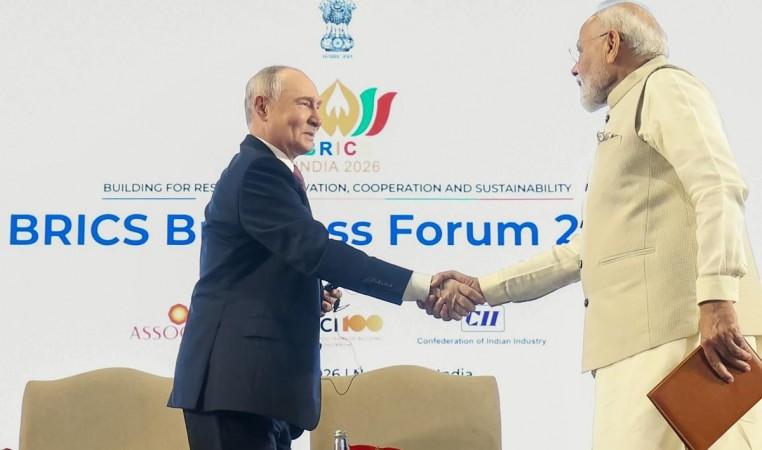
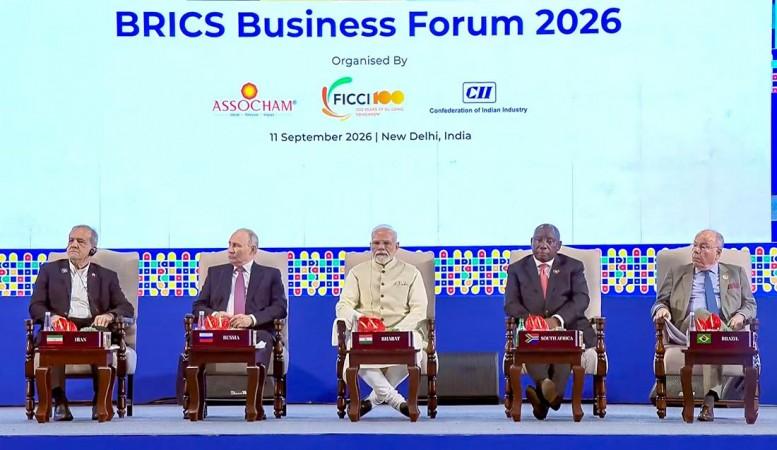
Prime Minister Narendra Modi on Friday highlighted the importance of maritime security for global trade, stressing that international commerce can function smoothly only when sea routes remain safe and secure.
Addressing the BRICS Business Forum in New Delhi, Modi referred to the importance of key maritime routes such as the Strait of Hormuz amid the ongoing crisis in West Asia and growing concerns over global trade and energy security.
"Global trade is possible only when sea routes are safe," the Prime Minister said, underlining the impact that disruptions to critical waterways can have on international commerce, supply chains and energy flows.
The Strait of Hormuz is one of the world's most strategically important waterways and a major route for global oil and gas shipments. Any disruption in the waterway can affect energy supplies, shipping costs and economies across the world.
Modi's remarks come as tensions in West Asia continue to pose challenges to maritime movement and global trade. India has consistently called for dialogue and diplomacy to resolve conflicts in the region while emphasising the importance of protecting civilians, commercial shipping and freedom of navigation.
India's BRICS presidency is creating fresh momentum for trade, investment and economic cooperation among member and partner countries, with business and institutional representatives from Russia, Egypt and other BRICS Plus nations expressing confidence in the opportunities emerging from the platform, industry leaders said on Friday.
Speaking to IANS on the sidelines of the BRICS Summit here, representatives from different sectors said the meetings had provided a valuable platform for businesses to explore partnerships in areas ranging from infrastructure and energy to technology, skills development and agriculture.
Alexander Kokov, Founder and CEO of Russian company GSBI Ltd, described the event as highly energetic and positive, saying participants were keen to work together and explore new opportunities.
He highlighted the business-to-business meetings organised during the summit, saying they had enabled entrepreneurs from different countries to engage directly and identify areas for cooperation. Kokov also praised industry body FICCI for facilitating business engagement and said being in India offered participants an opportunity to better understand the country's economic strength and growing market potential.
Kokov said there was significant scope for expanding trade, investment and economic ties between India and Russia, adding that the two countries were entering a phase that could lay the foundation for a stronger economic partnership in the years ahead.
He said his organisation works in the Global South Business Innovations and MICE (Meetings, Incentives, Conferences and Exhibitions) sector, which could serve as an important bridge for connecting the economic potential of BRICS countries. According to him, business conferences, exhibitions and other platforms for direct engagement could help turn discussions among member countries into concrete commercial projects.
Alina Singh, Deputy Director of Russia's Skills Development Agency, said BRICS brought together economies and societies with diverse cultures, experiences and perspectives.
"Member countries can share their experiences and expertise, learn from each other and promote collective development. That is the greatest strength of BRICS," she said.
Maxim Andrianov, International Marketing Manager at Russian Helicopters Group, also welcomed India's leadership of the grouping and praised the organisation of the summit.
He said the BRICS engagement this year had been highly productive, with participants establishing new business contacts and initiating discussions on several important projects.
Andrianov also pointed to the work of the BRICS Business Council, saying it had played an effective role in facilitating commercial engagement and strengthening business-to-business cooperation among participating countries.
On the 'Make in India' initiative, Andrianov said projects where local manufacturing requirements apply would operate within that framework. At the same time, he noted that companies in the commercial sector generally assess factors such as cost, efficiency and competitiveness while making business decisions, with affordability for consumers also remaining an important consideration.
Paroma Munshi Rebello, Head of Business Development at Pristine Logistics & Infraprojects Ltd, said her working group was focused on infrastructure, an area closely linked to investment.
Islam Salem, a representative of Egypt-based Iskra Maiden for Investment and Agricultural Development, said the potential for cooperation among BRICS economies was expanding and that the private sector would have a crucial role in converting those opportunities into actual partnerships.
"Discussions over the past two days on agriculture, technology, finance and several other sectors have clearly shown that there are significant opportunities for partnerships among member countries," Salem said.
Meanwhile, Iranian President Masoud Pezeshkian on Friday thanked India and Prime Minister Narendra Modi for hosting the BRICS Summit in New Delhi and making "valuable efforts" to strengthen cooperation among members of the grouping.
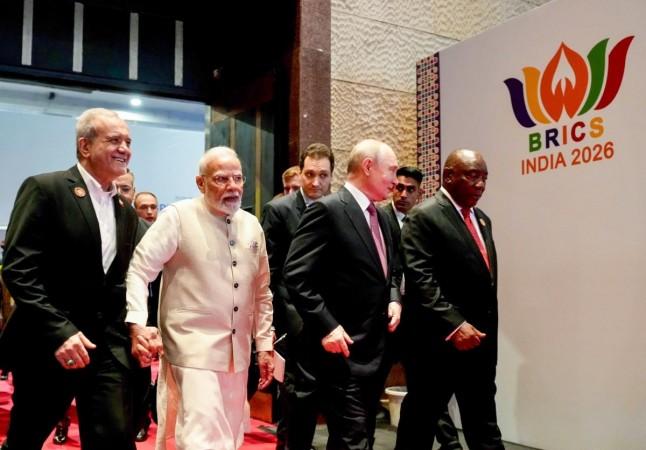
"I would like to sincerely thank the friendly government and people of India for the gracious hosting of this meeting, as well as the Honourable Prime Minister of India for his valuable efforts to strengthen BRICS cooperation," Pezeshkian said while addressing leaders, including Prime Minister Modi and Russian President Vladimir Putin, at the BRICS Business Forum held ahead of the summit.
"It is a source of great satisfaction for me to be present today among representatives of the private sector, business enterprises, and entrepreneurs who can transform the idea of cooperation within BRICS into tangible economic realities," he added.
Highlighting the ongoing conflict in West Asia and the resulting human and material losses, Pezeshkian said economic security remains inseparable from national and regional security.
"Economic security is inseparable from national and regional security, and whenever a country's trade, energy, infrastructure, or financial system is under political-military pressure, its effects will go beyond that country's borders," Pezeshkian was quoted as saying by Iran's leading Mehr news agency.
He said disruptions in supply chains and the increasing use of economic tools to exert political pressure had made the economic environment of countries more complex, and asked what response BRICS should offer to these challenges.
According to Pezeshkian, the true strength of BRICS is not limited to the economic size of its members but becomes more evident when those capacities are transformed into networks of joint trade, investment and financing.
He said Iran believes economic resilience is not possible without diversifying trade partners, financing and payment channels. Pezeshkian added that Iran had faced extensive sanctions over the past years, but claimed that these pressures had entered a "very difficult and dangerous stage" in recent months amid what he described as military aggression by the United States and Israel against Iran.
"This aggression, in addition to the human and material losses, has once again revealed an important reality: economic security is inseparable from national and regional security. Whenever a country's trade, energy, infrastructure, or financial system is under political-military pressure, its effects will go beyond the borders of that country and will affect regional stability and even the global economy," Pezeshkian said, according to Mehr.
Pezeshkian said BRICS must create an environment in which no country can disrupt another country's legitimate trade by monopolising a financial instrument or technology.
"To increase intra-BRICS trade, we must move from fragmented cooperation to gradual integration of trade infrastructures," he said.
He identified several measures in this regard, including digitalisation, integration of customs processes, trade facilitation, reduction of regulatory and administrative barriers, development of markets and facilitation of joint investment by the private sector.
The Iranian President also proposed establishing a BRICS joint reinsurance company with an initial capital of $10 billion to cover risks associated with large infrastructure and energy projects and increase confidence among private-sector investors.
Pezeshkian further highlighted the transformation taking place in the global economy with the rapid development of artificial intelligence, saying BRICS should not merely remain a consumer of technology but should also contribute to knowledge production and the development of standards for the digital economy.
He also called for stronger cybersecurity measures to protect critical infrastructure as BRICS economies deepen their technological and economic cooperation.