
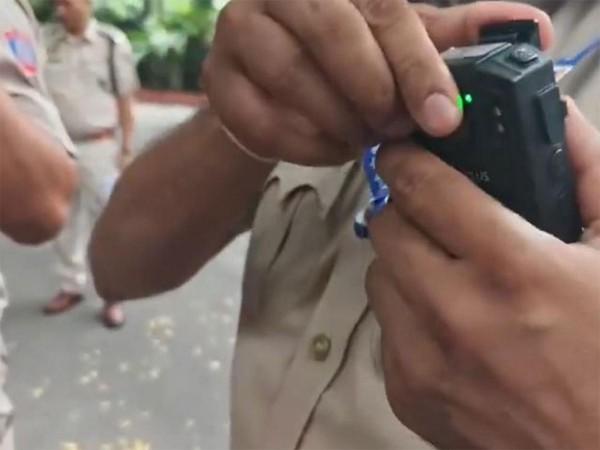
Delhi Police deployed body-worn cameras capable of recording in darkness as security was tightened across the national capital on Saturday, October 10, ahead of the Cockroach Janta Party (CJP) protest at Jantar Mantar demanding the resignation of Chief Election Commissioner Gyanesh Kumar.
Visuals shared by news agency ANI showed police personnel wearing cameras attached to their uniforms while managing security arrangements ahead of the proposed demonstration. A police personnel said the devices would help record interactions between officers and protesters, particularly during confrontations where allegations of manhandling or excessive force could arise.
"These body cams are to protect us and others," a police personnel, Deepak Chaudhary, told ANI, adding that the recordings could help establish what happened during an incident.
The deployment comes amid heightened security arrangements in Delhi, with police and paramilitary personnel stationed at key locations to prevent unauthorised gatherings and maintain law and order.
Delhi Police body cameras: Why are they being deployed?
The use of body-worn cameras has gained significance amid allegations of misconduct during recent protests and concerns over accountability during crowd-control operations.
The cameras are intended to create a visual record of interactions between police personnel and members of the public. Such recordings could help authorities examine complaints, establish the sequence of events and provide evidence when allegations are made against either police personnel or protesters.
The latest deployment comes as the CJP prepares to go ahead with its proposed demonstration at Jantar Mantar despite Delhi Police denying permission for the gathering.
Security arrangements have reportedly included barricading, vehicle checks at entry points, additional personnel and restrictions affecting public transport. Authorities have also taken measures to prevent protesters from assembling at unauthorised locations.
Delhi High Court declines plea seeking mandatory body cameras
The deployment comes days after the Delhi High Court declined to issue directions making body-worn cameras compulsory for Delhi Police and Rapid Action Force (RAF) personnel involved in protest management and crowd-control duties.
On October 7, a bench headed by Acting Chief Justice Nitin Sambre asked the Centre to consider a Public Interest Litigation (PIL) seeking mandatory and continuous use of body cameras as a representation and take a decision within six months.
The court questioned the need for judicial intervention, observing that the issue did not present a legal "grey area" requiring the court to direct the government to legislate.
The petition, filed by advocate Chahat Raghav, sought a binding Standard Operating Procedure (SOP) requiring police and RAF personnel deployed for demonstrations, crowd control and dispersal operations to wear and continuously operate body-worn cameras.
It also called for clear rules governing the preservation, storage, security and retention of recordings, along with safeguards to ensure that footage could be used as evidence.
The court's decision left the question of a compulsory, uniform framework for body-camera use to the government.
PIL raises concerns over police accountability during protests
The petition followed demonstrations held at Jantar Mantar in July involving the CJP and climate activist Sonam Wangchuk. It referred to allegations of excessive force by police and RAF personnel, as well as allegations of stone-pelting, vandalism and attacks on police officers.
The petitioner argued that much of the footage documenting the confrontations had been recorded by bystanders on mobile phones rather than through an official recording system worn by police personnel.
According to the plea, a mandatory body-camera system could provide a more reliable record of events and help establish what happened during encounters between law enforcement personnel and protesters.
The petition also sought safeguards to prevent unauthorised alteration or deletion of recordings and proposed secure storage systems and an auditable chain of custody.
It argued that the objective was to protect both police personnel and protesters by ensuring that allegations of misconduct could be examined using recorded evidence.
Delhi tightens security ahead of CJP protest
Delhi witnessed heightened security on October 10 ahead of the proposed CJP demonstration, which centres on demands for the resignation of Chief Election Commissioner Gyanesh Kumar over allegations linked to the Special Intensive Revision (SIR) of electoral rolls.
Police personnel were deployed at key intersections, transport hubs and sensitive locations, while barricades and vehicle checks were introduced to restrict unauthorised gatherings.
Reports also indicated that additional police and paramilitary personnel had been deployed across the capital, alongside measures affecting metro services and mobile internet access in parts of the city.
The demonstration has also brought renewed attention to the balance between maintaining public order and safeguarding the right to peaceful protest.
With body-worn cameras now being used by personnel on protest duty, their role in documenting police-public interactions and establishing evidence during confrontations is likely to remain a key issue in discussions around accountability and crowd management.