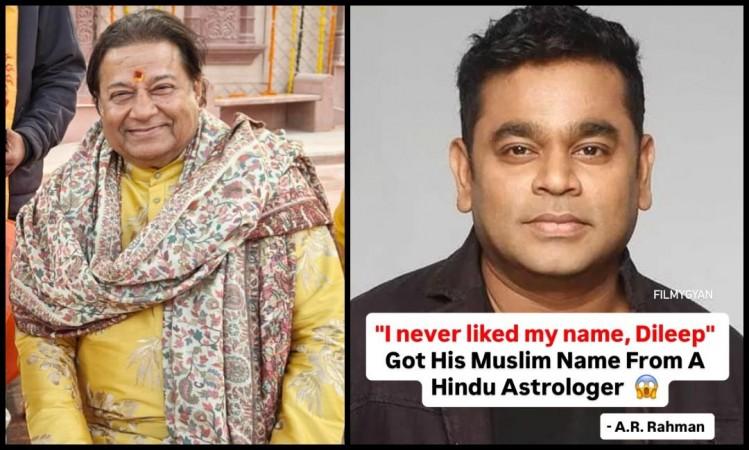
Music composer AR Rahman has been embroiled in controversy after, in an interview, he said that he might not be getting work in Bollywood due to a "power shift" and possible communal bias in the industry. His remarks about facing communal discrimination did not sit well with several celebrities, including Kangana Ranaut, Javed Akhtar, and Shaan. Meanwhile, a video of bhajan singer Anup Jalota has gone viral on social media, in which he is seen asking Rahman to reconvert to Hinduism.
In the video, Anup says, "Music director AR Rahman pehle Hindu the. Uske baad unhone Islam dharm apna liya aur bahut kaam kiya, bahut naam kamaya, logon ke dilon mein bahut achchi jagah banayi. Lekin agar unhein is baat ka vishwas hai ki hamare desh mein Musalman hone ki wajah se unko filmein nahi mil rahi music dene ke liye. Toh woh phir se Hindu ho jaayein (Music director AR Rahman was originally a Hindu. He then converted to Islam and did a lot of work, got fame, and earned a place in people's hearts. But if he believes that being a Muslim prevents him from getting work in films in the country, then he should become a Hindu again)."
The veteran singer further said, "Toh unko yeh vishwas hona chahiye ki unko Hindu hone se, convert ho jaane ke baad, phir se filmein milna shuru ho jaayengi. Yahi toh unka matlab hai. Toh mera sujhav hai woh Hindu ho jaayein aur phir try karein ki unko phir se filmein milti hai ke nahi (So, he must believe that by becoming Hindu, by converting, he will start getting films again. That's what he meant. So my suggestion is that he should become Hindu and then try to see if he can get films again)."
Anup Jalota: If AR Rahman feels that he is not getting work because he is a Muslim then he should convert and become Hindu again....???? pic.twitter.com/1NXBg5H2Hs
— Incognito (@Incognito_qfs) January 20, 2026
AR Rahman has remained in the headlines ever since clips from his BBC interview went
He said, "Maybe in the past eight years, because a power shift has happened, and people who are not creative have the power now. It might be a communal thing also, but it is not in my face. It comes to me as Chinese whispers that they booked you, but the music company went ahead and hired their five composers. I said, 'Oh, that's great. Rest for me. I can chill out with my family.'"
In the same interview, Rahman also described Vicky Kaushal's Chhaava as a divisive film.
"It is a divisive film. I think it cashed in on divisiveness, but the core of it is to show bravery. I had asked the director, 'Why did he need me for this film?' But he said that they needed only me. It is an enjoyable film, but people are smarter than that. Do you think people are going to get influenced by movies? They have an internal conscience that knows what is truth and what is manipulation," he said.
AR Rahman's daughter reacts
Amid the growing backlash, AR Rahman's daughter Raheema broke her silence and shared a strong message on social media. She wrote, "They don't have time to read the Bhagavad Gita, the Qur'an or the Bible — the sacred words that teach love, peace, discipline, and truth. But they have all the time in the world to argue, mock, provoke, abuse, and disrespect each other."
She further added, "This isn't religion. This is what blind society, half-baked education, toxic politics, and broken parenting have created, a generation more loyal to hate than to humanity."
Rahman breaks the silence after getting trolled
Following the backlash, AR Rahman released a video statement clarifying his stance. He said, "India is my inspiration, my teacher, and my home. I understand that intentions can sometimes be misunderstood. But my purpose has always been to uplift, honour, and serve through music. I have never wished to cause pain, and I hope my sincerity is felt. I feel blessed to be Indian, which enables me to create in a space that allows freedom of expression and celebrates multicultural voices."
He added, "I remain grateful to this nation and committed to music that honours the past, celebrates the present, and inspires the future. Jai Hind and Jai Ho."
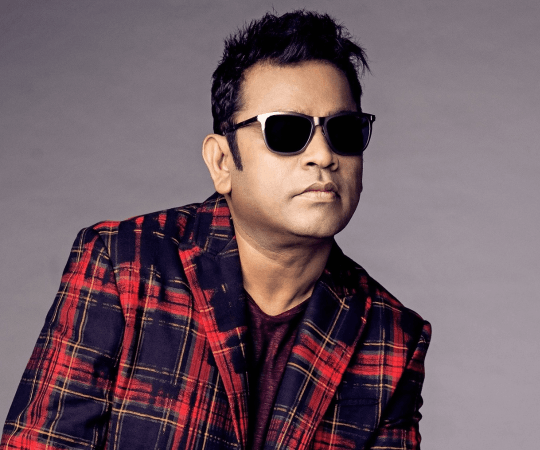
AR Rahman's real name
Not many know that AR Rahman, the legendary music composer, was born Dileep Kumar Rajagopala in Madras. His father, RK Shekhar, was also a film score composer but passed away when Rahman was just 9 years old, leaving the family to survive by renting out his father's musical instruments.
During these difficult times, Rahman felt hopeless. until he met the renowned Peer Qadri Saaheb, who inspired him deeply. At 23, he, along with his mother and sisters, converted to Islam. Rahman later shared in an interview with Karan Thapar that the encounter with the Sufi guided them onto a spiritual path that brought peace.
In his biography, AR Rahman: The Spirit of Music, by Nasreen Munni Kabir, he revealed he never liked his birth name. He recalled that a Hindu astrologer suggested the names Abdul Rahman and Abdul Rahim, and he instantly connected with Rahman, a name that truly reflected his identity.