There are 1.3 billion adults on earth with no bank account, no credit file, and no way to prove to a lender that they pay their bills on time. The number comes from the World Bank's Global Findex 2025 report, and it is not spread evenly: over half, about 650 million people, live in just eight countries, Bangladesh, China, Egypt, India, Indonesia, Mexico, Nigeria, and Pakistan.
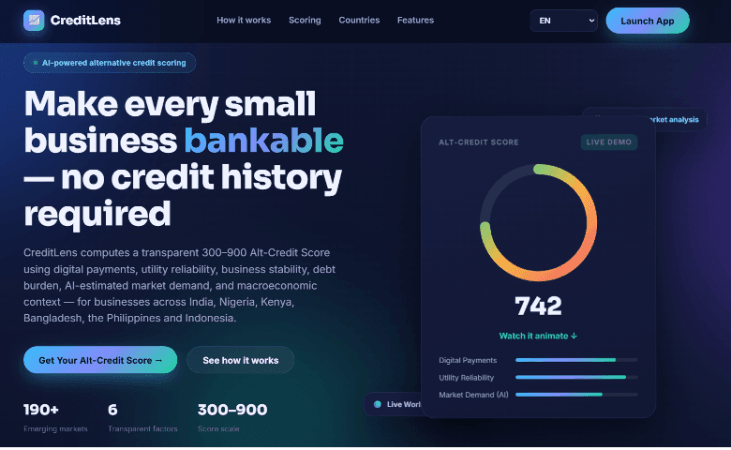
Six of those eight are places where a small business owner can open a laptop and, within about three minutes, obtain an instrument that resembles a credit score, built by one person in Visual Studio Code, not a bank, not an AI website generator. It is called CreditLens. The pitch: no credit history required.
The gap is data blindness, not a data shortage
The World Bank's own figures show that of the adults without a financial account, roughly 900 million already own a mobile phone, 530 million of those smartphones. These individuals are not invisible. They pay for mobile data, send money to relatives, and keep the lights on. That behavior is simply never recorded anywhere a bank is willing to look.
The IFC's March 2025 MSME Finance Gap Report quantifies what that blindness costs: a $5.7 trillion financing gap for small businesses across 119 emerging economies, closer to $8 trillion counting informal ones. Forty percent of formal MSMEs are credit-constrained, not because they are poor businesses, but because no institution has built a form for what they actually possess.
That is the exact gap CreditLens targets. Its four-step wizard requests information already present on a merchant's phone: transaction volume, weekly digital payments, weeks with no activity, and how reliably utility bills are paid.
What it actually feels like to use
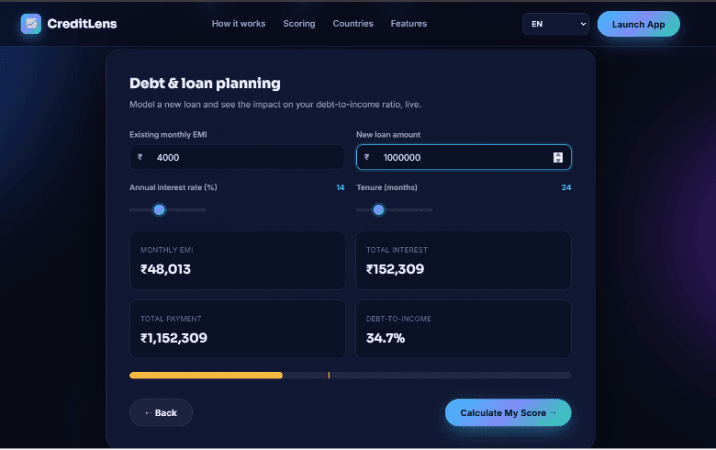
Consider a shop owner in Lagos, most of whose sales run through mobile money. She selects her country from an interactive globe, which indicates which local payment rails the tool is about to analyze: M-Pesa, UPI, bKash. Step two addresses her business: industry, revenue, and the proportion of transactions conducted digitally. Step three is a loan planner that models a new loan in real time and does not allow the resulting figure to exceed a 45 percent debt-to-income ratio without issuing a warning to borrow less or extend the repayment period, a safeguard that much predatory lending depends on bypassing. By step four, she receives a score between 300 and 900, a plain-language breakdown of which factors helped or hurt it, and a written summary in place of a spreadsheet.
A proven category, minus the black box
None of this is untested. Tala, Branch, and Jumo have operated mobile-data credit scoring across Kenya, Nigeria, the Philippines, and Mexico for a decade, and Branch alone has disbursed more than $600 million to over three million customers based on phone metadata rather than bureau files. The honest framing is not that CreditLens invented this approach, but that the category already works, and most products within it remain opaque about their methodology.
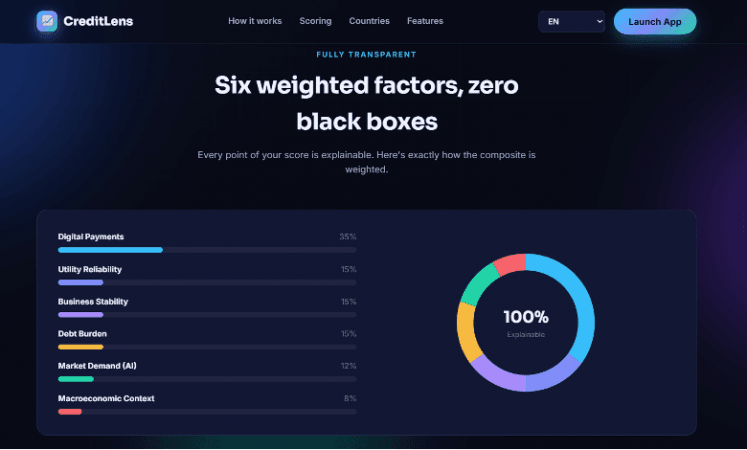
That opacity is the central criticism this sector has earned. Research on AI-driven underwriting warns that alternative data can function as an unlawful proxy for race or gender, and models trained on historically unequal lending data tend to reproduce that bias rather than correct it. CreditLens responds with hardcoded logic rather than a trained model: six weighted factors with fixed, disclosed percentages, digital payments at 35 percent, utility reliability, business stability, and debt burden at 15 percent each, AI-estimated market demand at 12 percent, and macroeconomic context at 8 percent. Every score displays which factor influenced it. Gemini, the artificial intelligence component of the product, is confined to the market-demand estimate and the chat assistant, kept apart from the actual decision. A transparent, if unglamorous, methodology is arguably preferable to one that is clever but opaque.
Restricting the AI's role in this manner is a response to a real weakness, not merely a design choice.
Where AI still can't be trusted
Large language models hallucinate, and they are inconsistent across languages in ways that are difficult to detect until failures surface in production. A chatbot providing incorrect information about loan eligibility is not a minor defect, it is a real financial harm to someone with little margin for error. There is also a consent problem that alternative-data scoring rarely resolves: a lender able to see transaction timing and utility habits holds a detailed financial portrait assembled without formal consent. CreditLens does not resolve this, it simply confines the AI to two functions and states plainly on screen when it is operating in offline demo mode, a degree of honesty most consumer fintech products do not offer.
Built for the borrower, and the bank
The obvious audience is the business owner who has never had a bank extend approval. The less obvious audience is the lender: underwriting a thin-file borrower today requires a loan officer to work through incomplete documentation by hand, and a standardized score would substantially reduce the time required, although no regulator is likely to permit a bank to bypass its own KYC checks solely because a score exists. In practice, this functions as a triage layer rather than a replacement for underwriting.
Nor is the approach templated. CreditLens maps real, country-specific payment rails, UPI and Aadhaar in India, M-Pesa in Kenya, bKash in Bangladesh, across twelve markets, a distinction that matters because UPI alone processed more than 20 billion transactions in August 2025 and now accounts for 85 percent of India's digital transactions. Treating digital payments as a single generic field would misread a market of that scale entirely.
What this means at scale, and what it risks
McKinsey Global Institute's often-cited 2016 study found that widespread digital finance adoption could add 6 percent to emerging-market GDP, approximately $3.7 trillion, and generate up to 95 million jobs, primarily from the shift of transactions off cash. MSMEs account for 90 percent of firms and 70 percent of employment worldwide, so a working-capital loan to a single shop owner tends to mean she hires a fourth employee, not merely retains her current three, the actual chain connecting a scoring wizard to a GDP figure. A resilience dimension exists as well: a business with even a thin credit relationship survives a shock that would end one with none. A further dimension concerns inclusion: IFC research finds that women borrowers often perform as well as, or better than, men under alternative-data models, and women-owned MSMEs carry 34 percent of the entire finance gap.
A less encouraging point follows. Adopted widely, a biased weighting ceases to be a single application's problem and becomes a policy failure, one that is harder to detect because, by the time it becomes visible, lending decisions have already been built upon it.
A second, quieter risk exists. CreditLens relies on a foreign AI provider for two features, and if scaled across markets, a portion of each country's economic decision-making would reside on a server it neither owns nor audits. This is not an argument against building the tool, but an indication of what a real path to national infrastructure would require: local hosting, local audit rights, and a regulator with actual veto power over the model, not merely the interface layered on top of it.
What this is, and isn't, yet
CreditLens remains a working demonstration, not a live lending product. Progressing from this stage to an instrument a bank could deploy would require bureau partnerships, bias audits, and a licensing conversation in every market it claims to cover, the same gap every fintech in this sector has had to cross. Nor was it built by a funded team or an AI website generator, it is the work of one person, with twelve markets researched individually, developed in a Visual Studio Code project folder. That is the instinct that ought to drive the entire category: 1.3 billion people are already generating the proof a lender would want. Someone need only build the instrument that reads it, discloses its methodology, and does not pretend a chatbot can substitute for a compliance officer.
[Disclaimer: This is a guest post by Aarav Roy, a Grade 11 student at Ahmedabad International School, currently in the IB Diploma Programme.]